
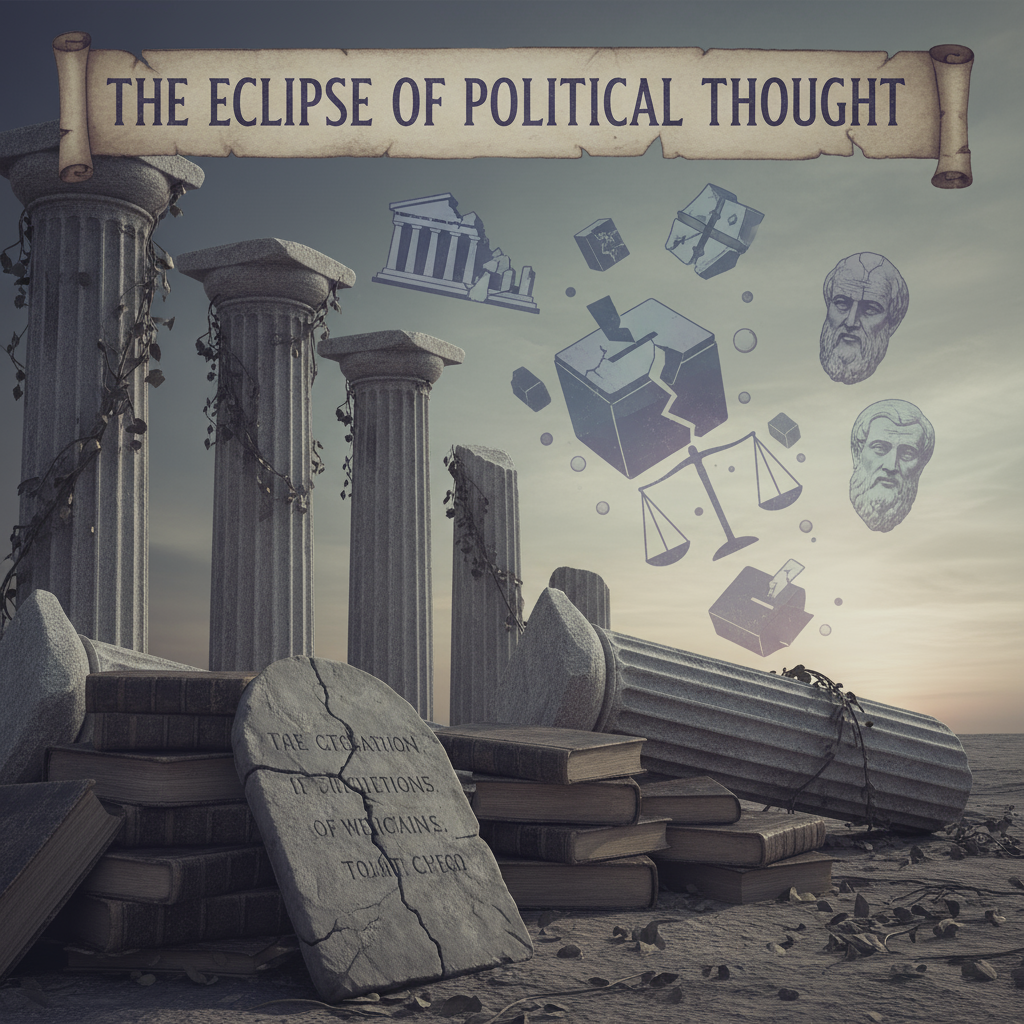
Comment on Decline of political theory [2023/10m/150w/1e]
The “decline of political theory” is one of the most debated themes in political science, often appearing in UPSC PSIR Paper I under the section on political theory. The issue reflects the tension between normative political philosophy and empirical political science. For aspirants, this debate is not just theoretical—it highlights the changing nature of political inquiry and its relevance in addressing contemporary issues like democracy, justice, and global challenges.
This blog post provides a UPSC model answer with a critical and analytical approach, integrating the views of scholars such as David Easton, Leo Strauss, Sheldon Wolin, Robert Dahl, Isaiah Berlin, John Rawls, and Habermas. It will also demonstrate how political theory, far from disappearing, has undergone transformation and resurgence.
Understanding the Decline of Political Theory
The decline debate emerged prominently after World War II, when political science embraced the behavioral revolution. The aim was to make the discipline more “scientific,” focusing on observation, quantification, and empirical validation.
- David Easton (1951) described this as a shift from normative, prescriptive inquiry to a descriptive and value-neutral science.
- Traditional political theory—centered around justice, liberty, and authority—was dismissed as speculative and unscientific.
- Institutional marginalization occurred in universities, with reduced emphasis on classical texts and more focus on quantitative methodologies.
Thinkers like Leo Strauss strongly criticized this trend, calling it a “crisis of political philosophy.” He warned that by abandoning moral judgment, political science was losing its ability to guide society.
Theoretical Dimensions of the Decline
The debate over decline can be unpacked at multiple levels:
1. Methodological Shift
- The dominance of positivism emphasized neutrality and objectivity.
- Sheldon Wolin argued that true political theory required “epic theorizing”—a balance between normative vision and empirical grounding—something lost in excessive specialization.
2. Behavioralist Critique
- Robert Dahl and other behavioralists claimed that political theory lacked empirical testability.
- To them, without data-driven hypotheses, political theory could not be considered scientific.
3. Interpretivist Response
- Thinkers like Isaiah Berlin and Charles Taylor emphasized that politics inherently involves values, identities, and meanings.
- Hence, a purely empirical approach misses the normative essence of political life.
👉 In UPSC terms, this shows how political theory was squeezed between the empirical-positivist camp and the normative-interpretivist defense.
Revival and Transformation of Political Theory
Despite its supposed decline, political theory experienced resurgence from the 1970s onward.
1. Revival of Normative Theory
- John Rawls’ A Theory of Justice (1971) re-established systematic normative theory in political science.
- Robert Nozick’s libertarian response (Anarchy, State, and Utopia) further enriched debates on justice and state authority.
2. Expansion into New Domains
- Feminist theory (Carole Pateman, Susan Okin).
- Critical race theory and postcolonial theory.
- Environmental political theory engaging with climate justice.
3. Integration of Normative and Empirical
- Jürgen Habermas: discourse ethics bridged democracy with communicative rationality.
- Amartya Sen and Martha Nussbaum: capability approach combined ethical reasoning with development economics.
- Constructivists in IR: demonstrated how ideas, norms, and identity shape global politics.
Contemporary Relevance of Political Theory
Far from being obsolete, political theory has renewed importance:
- Globalization: raises questions of global justice, migration, and sovereignty.
- Climate change: demands ethical frameworks for sustainability.
- Democratic backsliding: needs normative defense of liberal institutions.
- Technology and AI: calls for debates on ethics, privacy, and human dignity.
Thus, political theory equips us with frameworks to critically assess issues that data alone cannot answer.
Critical Analysis
- The decline thesis reflected disciplinary insecurity rather than real death of theory.
- The debate revealed a false binary between empirical and normative; in practice, all political inquiry carries value commitments.
- Today, political theory is not in decline but has diversified and globalized—moving beyond Western-centric frameworks to include feminist, postcolonial, and non-Western perspectives.
As Easton later admitted, the field required synthesis, not separation, between normative and empirical approaches.
Conclusion
The debate on the “decline of political theory” highlights the discipline’s struggle between scientific aspiration and philosophical depth. While mid-20th century behavioralism marginalized normative inquiry, the subsequent revival through Rawls, Nozick, Habermas, Sen, and others shows political theory’s resilience and adaptability.
For UPSC aspirants, the takeaway is clear:
- Political theory is not dead—it has transformed.
- Questions of justice, freedom, and legitimacy remain central.
- The future of political theory lies in creating integrated frameworks that respond to globalization, technology, and environmental crises.
👉 Thus, rather than a decline, political theory represents an evolving conversation between values and realities, keeping the discipline of political science alive and relevant.
Quick Revision Pointers for UPSC
- Easton: Political theory declined due to behavioral revolution.
- Strauss: Crisis of political philosophy.
- Wolin: Need for epic theorizing.
- Dahl: Lack of empirical grounding.
- Berlin/Taylor: Importance of values and meanings.
- Rawls & Nozick: Revival of normative theory.
- Habermas, Sen, Nussbaum: Integration of normative and empirical.
- Contemporary relevance: globalization, climate, democracy, technology.
FAQs on Decline of Political Theory (UPSC PSIR)
Q1. What is meant by the “decline of political theory”?
It refers to the post–World War II marginalization of normative political philosophy due to the rise of the behavioral revolution and emphasis on scientific methods.
Q2. Why did political theory decline in the mid-20th century?
Because behavioralists like David Easton and Robert Dahl prioritized empirical, quantitative, and value-neutral approaches over normative reasoning.
Q3. How did critics respond to this decline?
Thinkers like Leo Strauss, Sheldon Wolin, and Isaiah Berlin argued that abandoning values and moral judgment created a crisis in political philosophy.
Q4. How was political theory revived?
The revival came through John Rawls’ A Theory of Justice (1971), Robert Nozick’s libertarian critique, and later expansions into feminist, postcolonial, and environmental theory.
Q5. Is political theory relevant for UPSC today?
Yes, it remains vital as it addresses contemporary issues like democracy, justice, globalization, and climate change—making it central to PSIR Paper I, GS-II, and Essay.
About The Author
