
Q. Consider the following statements:
I. India has joined the Minerals Security Partnership as a member.
II. India is a resource-rich country in all the 30 critical minerals that it has identified.
III. The Parliament in 2023 has amended the Mines and Minerals (Development and Regulation) Act, 1957 empowering the Central Government to exclusively auction mining lease and composite license for certain critical minerals.
Which of the statements given above are correct?
[A] I and II only
[B] II and III only
[C] I and III only
[D] I, II and III
Answer with Explanation
✅ Correct Option: [C] I and III only
- Statement I is correct → India joined the Minerals Security Partnership (MSP) in June 2023 as its 14th member. MSP is a U.S.-led initiative to strengthen and diversify global supply chains of critical minerals.
- Statement II is incorrect → India is not resource-rich in all 30 identified critical minerals. India largely depends on imports for Lithium, Cobalt, Nickel, REEs (Rare Earth Elements) etc. To address this, the National Critical Mineral Mission (NCMM, 2025) has been launched.
- Statement III is correct → The Mines and Minerals (Development and Regulation) Act, 1957 was amended in 2023 to empower the Central Government to exclusively auction mining leases and composite licenses for 24 critical minerals (Lithium, Niobium, Rare Earths, etc.) listed in the new Part-D of First Schedule of the Act.
🔎 About Minerals Security Partnership (MSP)
- Launched in 2022 by the United States with partner nations.
- Aims to ensure secure, transparent, and sustainable supply chains for critical minerals.
- Focus minerals → Lithium, Cobalt, Nickel, Graphite, Rare Earths.
- Members include: US, EU, Australia, Canada, Japan, South Korea, UK, and India (14th member).
Also See: Business Responsibility and Sustainability Report: UPSC Prelims Question
🧾 What are Critical Minerals?
- Minerals that are essential for economic growth, clean energy, defense, and high-tech manufacturing but face supply chain vulnerability.
- Examples → Lithium, Cobalt, Nickel, Rare Earth Elements, Titanium, Gallium, Germanium, Vanadium.
📌 Major Producers Globally: China, Chile, Australia, Democratic Republic of Congo, South Africa, Indonesia.
📊 India’s List of 30 Critical Minerals (2023)
Categorised Usage
| Category | Examples | Applications | India’s Status |
|---|---|---|---|
| Battery Minerals | Lithium, Cobalt, Nickel, Graphite | Electric Vehicle batteries, Energy storage | Mostly import-dependent |
| High-tech / Strategic Metals | Gallium, Germanium, Indium, Beryllium, Niobium, Tantalum | Semiconductors, Electronics, Aerospace, Defense | Limited reserves |
| Rare Earth Elements (REEs) | Lanthanides, Yttrium, Scandium | Magnets for Wind Turbines, Missiles, Drones | Low production, import reliance |
| Industrial Minerals | Potash, Phosphorous, Titanium, Molybdenum | Fertilizers, Alloys | Moderate availability |
| Traditional Resources | Copper, Chromium, Silicon | Steel, Solar panels, Electrical | Partially available |
⚖️ Mines and Minerals (Development and Regulation) Act, 1957 – 2023 Amendment
- Added Part-D to First Schedule → 24 critical minerals reserved for Central auctioning.
- Focus → Lithium-bearing minerals, Niobium, Rare Earths (not containing Uranium & Thorium).
- Promotes sustainable mining, deep-seated exploration, offshore mining.
- Established mineral exchanges and renamed NMET → NMEDT (National Mineral Exploration and Development Trust).
Also See: Sources of Income of RBI: UPSC Prelims 2025 Question
🚀 National Critical Mineral Mission (NCMM, 2025)
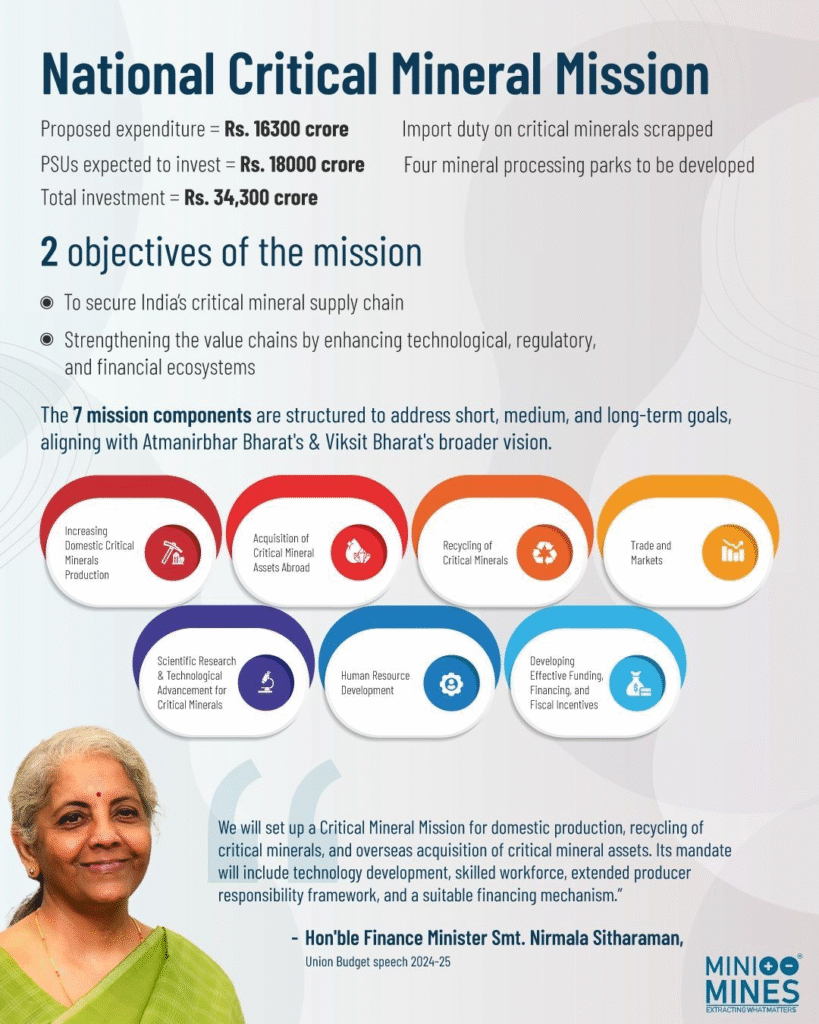
- Objective → Achieve self-reliance in critical minerals.
- Geological Survey of India (GSI) to conduct 1,200 exploration projects (2024–31).
- Agencies like KABIL (Khanij Bidesh India Ltd.) to secure overseas mineral assets.
- Set up a Centre of Excellence on Critical Minerals (CECM).
- India’s Ministry of Mines has recognized seven institutions as Centres of Excellence (CoEs) under the National Critical Minerals Mission (NCMM) to drive research and innovation in critical minerals. These CoEs include four IITs—Bombay, Hyderabad, ISM Dhanbad, and Roorkee—and three research labs: CSIR-IMMT Bhubaneswar, CSIR-NML Jamshedpur, and NFTDC Hyderabad. Each CoE operates as a hub, collaborating with industry and academic “spokes” to advance R&D across the critical mineral value chain.
📌 Usage of Critical Minerals
- Solar Energy → Silicon, Tellurium, Indium, Gallium for PV cells.
- Wind Energy → REEs (Dysprosium, Neodymium) for turbine magnets.
- Electric Vehicles (EVs) → Lithium, Nickel, Cobalt for Li-ion batteries.
- Defense & Aerospace → Rare Earths, Titanium, Beryllium in fighter jets, drones, and missiles.
- Semiconductors → Gallium, Germanium, Indium for chip manufacturing.
🧠 Mnemonic to Remember Critical Mineral Usage
👉 “SEED Power”
- S → Solar (Silicon, Indium, Gallium)
- E → EVs (Lithium, Cobalt, Nickel)
- E → Energy storage (Graphite, Lithium)
- D → Defense (REEs, Titanium, Beryllium)
Also See: Alternative Investment Funds – UPSC Prelims 2025
📚 Comparison: India vs Global in Critical Minerals
| Aspect | India | Global Leaders |
|---|---|---|
| Lithium | Limited resources | Chile, Australia, Argentina |
| Cobalt | Import-dependent | DRC, Indonesia |
| Nickel | Minor reserves | Indonesia, Philippines |
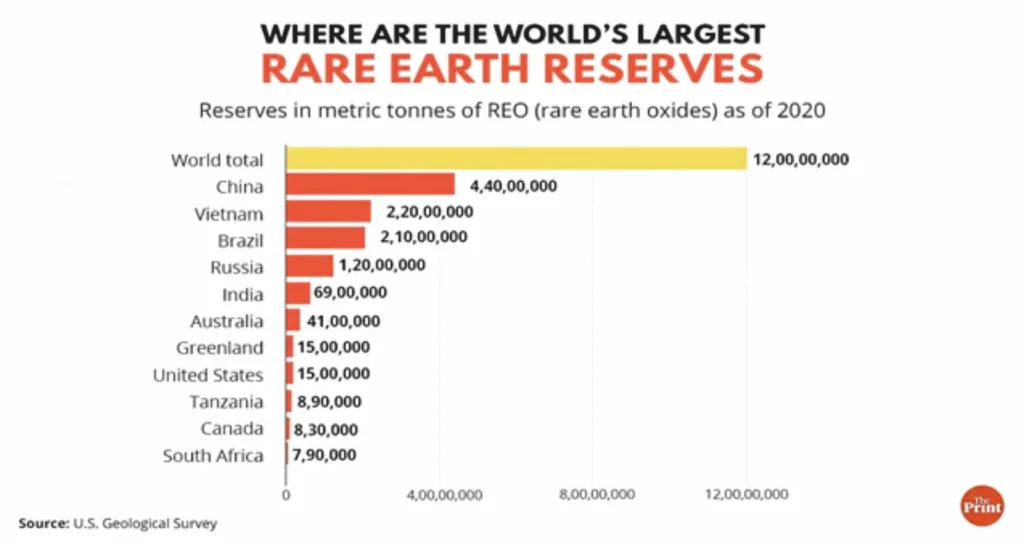
| Rare Earths | Small capacity | China dominates (>60%) |
| Exploration Projects | 1,200 projects planned (2024–31) | Well-developed in Australia, Canada |
📝 Prelims Practice Questions
Q1. Which of the following are part of India’s identified list of 30 critical minerals?
- Lithium
- Potash
- Uranium
- Cobalt
[A] 1, 2 and 4 only
[B] 1 and 3 only
[C] 2, 3 and 4 only
[D] 1, 2, 3 and 4
👉 Answer: [A] 1, 2 and 4 only (Uranium is excluded as it is regulated separately under atomic energy laws).
Q2. With reference to the Minerals Security Partnership (MSP), consider the following:
- It was launched by BRICS countries.
- It focuses on strengthening supply chains of critical minerals.
- India is a founding member of this partnership.
Which of the above is/are correct?
[A] 1 and 2 only
[B] 2 only
[C] 2 and 3 only
[D] 1, 2 and 3
👉 Answer: [B] 2 only
Also See: Key Government Directorates under Department of Revenue
Consider the following minerals: (2020)
- Bentonite
- Chromite
- Kyanite
- Sillimanite
In India, which of the above is/are officially designated as major minerals?
(A) 1 and 2 only
(B) 4 only
(C) 1 and 3 only
(D) 2, 3 and 4 only
Ans: D
Recently, there has been a concern over the short supply of a group of elements called ‘rare earth metals’. Why? (2012)
- China, which is the largest producer of these elements, has imposed some restrictions on their export.
- Other than China, Australia, Canada and Chile, these elements are not found in any country.
- Rare earth metals are essential for the manufacture of various kinds of electronic items and there is a growing demand for these elements.
Which of the statements given above is/are correct?
(A) 1 only
(B) 2 and 3 only
(C) 1 and 3 only
(D) 1, 2 and 3
Ans: C
Q. With reference to the management of minor minerals in India, consider the following statements: (2019)
- Sand is a ‘minor mineral’ according to the prevailing law in the country
- State Governments have the power to grant mining leases of minor minerals, but the pwers regarding the formation of rules related to the grant of minor minerals lie with the Coentral Government.
- State Governments have the power to frame rules to prevent illegal mining of minor minerals.
Which of the statements given above is/are correct?
(a) 1 and 3 only
(b) 2 and 3 only
(c) 3 only
(d) 1, 2 and 3
Ans: (a)
Q. What is/are the purpose/purposes of ‘District Mineral Foundations’ in India? (2016)
- Promoting mineral exploration activities in mineral-rich districts
- Protecting the interests of the persons affected by mining operations
- Authorizing State Governments to issue licenses for mineral exploration
Select the correct answer using the code given below:
(a) 1 and 2 only
(b) 2 only
(c) 1 and 3 only
(d) 1, 2 and 3
Ans: (b)
❓ FAQs on Critical Minerals and MSP
Q1. Why are critical minerals important for India?
They are essential for energy transition, defense, electronics, EVs, and food security, but India is heavily dependent on imports for many.
Q2. How does the Minerals Security Partnership help India?
It enables collaboration, technology transfer, and investment opportunities in securing supply chains of Lithium, Cobalt, Nickel, and REEs.
Q3. How is NCMM different from MMDR Act amendments?
NCMM → Policy framework for exploration, processing, and overseas tie-ups.
MMDR Amendment (2023) → Legal empowerment of Centre to auction critical minerals and regulate mining.
Q4. Does India have a monopoly in any critical mineral?
No. India has moderate reserves of some minerals (like rare earths, titanium), but depends on imports for most battery and semiconductor minerals.
About The Author
