
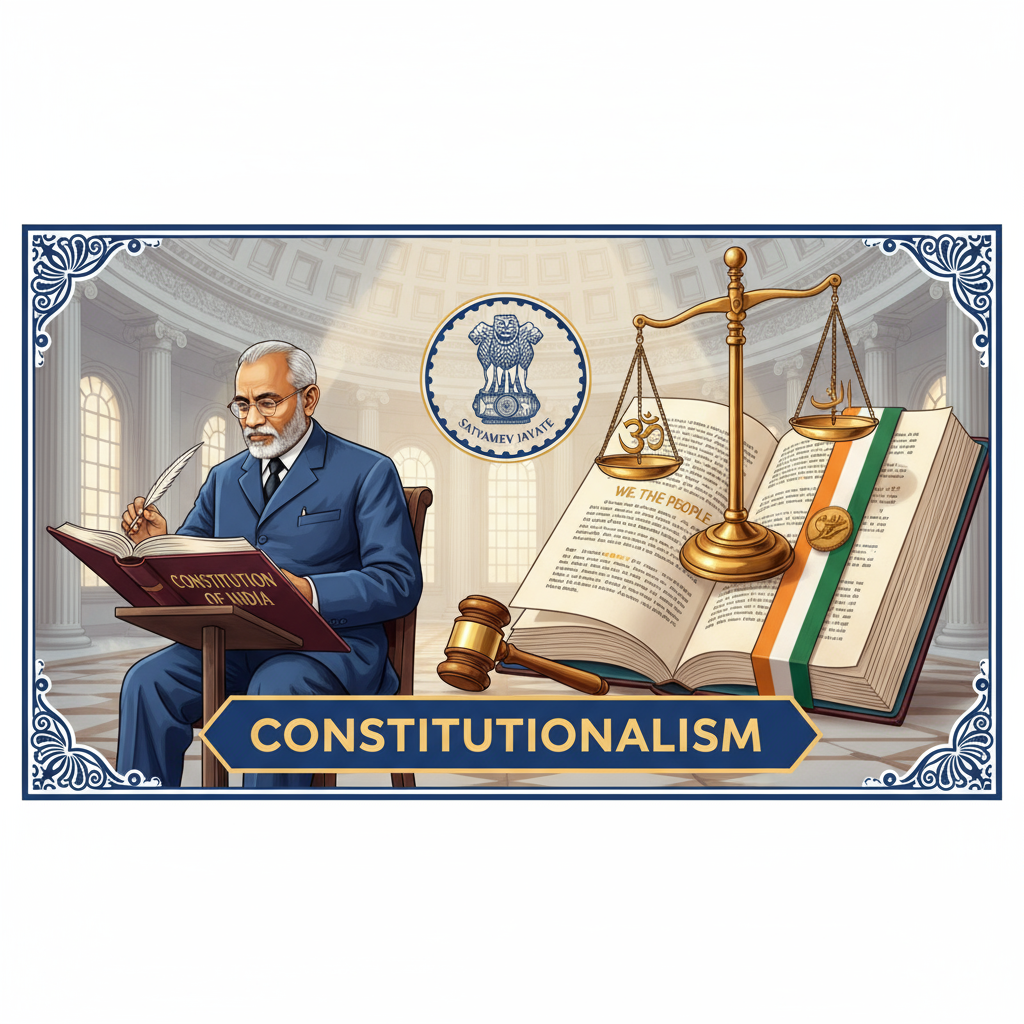
Comment on Ambedkar’s ideas on constitutionalism. [2020/10m/150w/1d]
B.R. Ambedkar, the chief architect of the Indian Constitution, stands as one of the most original thinkers of modern India. His conception of constitutionalism cannot be reduced to mere legal formalism; rather, it was a transformative project aimed at dismantling social hierarchies, especially caste-based oppression.
For UPSC PSIR aspirants, Ambedkar’s ideas are crucial not only for Paper I (political theory and constitutionalism) but also for Paper II (Indian political thought and Constitution).
Unlike classical liberal thinkers who emphasized negative liberty and procedural equality, Ambedkar insisted that constitutionalism must guarantee substantive equality, social democracy, and protective mechanisms for historically marginalized communities. In this sense, his thought foreshadowed what scholars today call “transformative constitutionalism.”
This blogpost provides a scholarly, aspirant-friendly, and exam-oriented model answer on Ambedkar’s conception of constitutionalism.
Theoretical Foundations of Ambedkar’s Constitutionalism
Ambedkar’s constitutional philosophy was shaped by both Western liberal thought and Indian social realities:
- Influence of J.S. Mill & American Constitutionalism
- At Columbia University, Ambedkar studied John Dewey and J.S. Mill. He imbibed their emphasis on liberty and democratic participation.
- However, unlike the American model, Ambedkar argued that liberty could not exist in a society fractured by caste hierarchies.
- Harold Laski & Social Democracy
- Ambedkar’s thought reflected Laski’s critique of formal democracy without economic and social equality.
- He insisted that political democracy without social democracy was a “house built on sand.”
- Beyond Western Liberalism
- Ambedkar synthesized liberal constitutionalism with Indian realities, rejecting Brahmanical social order.
- His vision aligned more with positive constitutionalism — where the state actively dismantles structural inequalities.
Core Elements of Ambedkar’s Constitutional Vision
1. Fundamental Rights as Social Revolution
- Ambedkar saw Fundamental Rights as tools of social transformation, not just individual liberties.
- Articles 14–18 (equality before law, prohibition of discrimination, abolition of untouchability, abolition of titles) were drafted as direct attacks on caste oppression.
- As Rousseau argued that true freedom requires removal of artificial distinctions, Ambedkar designed rights to legally annihilate caste.
2. Constitutional Morality
- Borrowing George Grote’s concept, Ambedkar argued that constitutional morality was essential in India.
- He distinguished it from social morality, which in India was hierarchical and exclusionary.
- His insistence on liberty, equality, and fraternity challenged Gandhi’s faith in moral reform through satyagraha, placing emphasis instead on binding legal-constitutional norms.
3. Protective Discrimination (Reservations)
- Ambedkar strongly supported affirmative action (Articles 15(4), 330, 332, 335).
- He anticipated what John Rawls would later articulate as the “difference principle”: that inequalities are justifiable only if they benefit the disadvantaged.
- Protective discrimination, therefore, became a constitutional tool to bridge historical injustices.
Also View: M.N. Roy’s Humanistic Marxism: Radical Humanism and Its Contemporary Relevance for UPSC PSIR
Institutional Design and Governance
1. Parliamentary Democracy with Social Content
- While India borrowed the Westminster parliamentary system, Ambedkar infused it with social democratic objectives.
- Cabinet responsibility (Article 75) and collective accountability were not just procedural but meant to make governance inclusive.
2. Federalism with Unitary Bias
- Ambedkar argued that India needed a strong Centre to overcome social and regional fragmentation.
- His support for the Concurrent List and emergency provisions (Articles 352–360) reflected his prioritization of unity and equality over states’ rights.
3. Independent Judiciary
- Inspired by American constitutionalism and Montesquieu’s separation of powers, Ambedkar envisioned the judiciary as a guardian of rights and social justice.
- Articles 124–147 enshrined judicial independence, giving courts the role of ensuring that liberty, equality, and fraternity are not compromised.
Critical Assessment and Contemporary Relevance
- Transformative Constitutionalism
- Ambedkar’s ideas resonate with the modern doctrine of transformative constitutionalism, now frequently invoked by the Supreme Court (e.g., Navtej Johar v. Union of India, 2018 on LGBTQ+ rights).
- Scholars like Upendra Baxi emphasize that Ambedkar gave constitutionalism a radical social content absent in most Western democracies.
- Critiques of Legal Formalism
- Some critics argue Ambedkar over-relied on state and legal institutions to transform society, underestimating civil society and grassroots movements.
- His conflict with Gandhi over separate electorates highlighted this tension — Ambedkar wanted institutional safeguards, Gandhi emphasized moral persuasion.
- Relevance in Today’s India
- Debates on caste census, reservation in promotions, and judicial activism show that Ambedkar’s concerns about substantive equality remain unresolved.
- His stress on constitutional morality is vital in today’s climate of majoritarian pressures.
Conclusion
Ambedkar’s constitutionalism was neither a blind imitation of Western liberalism nor a simple legal manual. It was a synthesis of liberal democracy, social democracy, and anti-caste consciousness. His transformative vision ensured that the Constitution was not merely a political document but also a social charter.
For UPSC aspirants, the key takeaway is this: Ambedkar reminds us that political democracy without social democracy is incomplete. His insistence on liberty, equality, and fraternity continues to guide constitutional debates, not only in India but across democracies grappling with structural inequalities.
Also View: Explicate the Ideological Components of Gandhism – UPSC PSIR Model Answer
📌 Quick Revision Table: Ambedkar’s Constitutionalism
| Scholar / Thinker | Core Concept / Influence | Ambedkar’s Interpretation in Constitutionalism |
|---|---|---|
| John Stuart Mill | Liberty, representative government | Liberty not possible without annihilation of caste; political democracy must be substantive |
| John Dewey (Columbia) | Pragmatism, democracy as a way of life | Inspired Ambedkar’s idea of democracy as a social ethic, not mere procedure |
| Harold Laski | Social democracy, critique of formal democracy | Political democracy must be backed by social & economic democracy |
| George Grote | Constitutional morality | Indians must learn constitutional morality over traditional (hierarchical) social morality |
| Montesquieu | Separation of powers | Independent judiciary as guardian of rights |
| Jean Jacques Rousseau | Freedom requires elimination of artificial distinctions | Reflected in Articles 14–18: equality, abolition of untouchability, anti-discrimination |
| John Rawls (later parallel) | Difference principle – inequalities must benefit the least advantaged (1971) | Ambedkar prefigured this in advocacy of reservations & protective discrimination |
| Upendra Baxi (modern) | Transformative constitutionalism in India | Sees Ambedkar as pioneer of rights-based social transformation |
| Marc Galanter | Study of reservations, “Compensatory discrimination” | Validates Ambedkar’s framework of substantive equality |
FAQs
Q1. Why is Ambedkar’s constitutionalism important for UPSC PSIR?
Because it bridges political theory (constitutionalism, liberalism, social justice) with Indian political thought, making it high-yield for both Paper I & II.
Q2. What is the difference between constitutional morality and social morality in Ambedkar’s thought?
Social morality in India was hierarchical (caste-based). Constitutional morality is about liberty, equality, fraternity, and adherence to the Constitution’s spirit.
Q3. How does Ambedkar’s constitutionalism differ from Gandhi’s approach?
Ambedkar emphasized legal safeguards; Gandhi emphasized moral transformation through satyagraha.
About The Author

Hi, this is a comment.
To get started with moderating, editing, and deleting comments, please visit the Comments screen in the dashboard.
Commenter avatars come from Gravatar.