
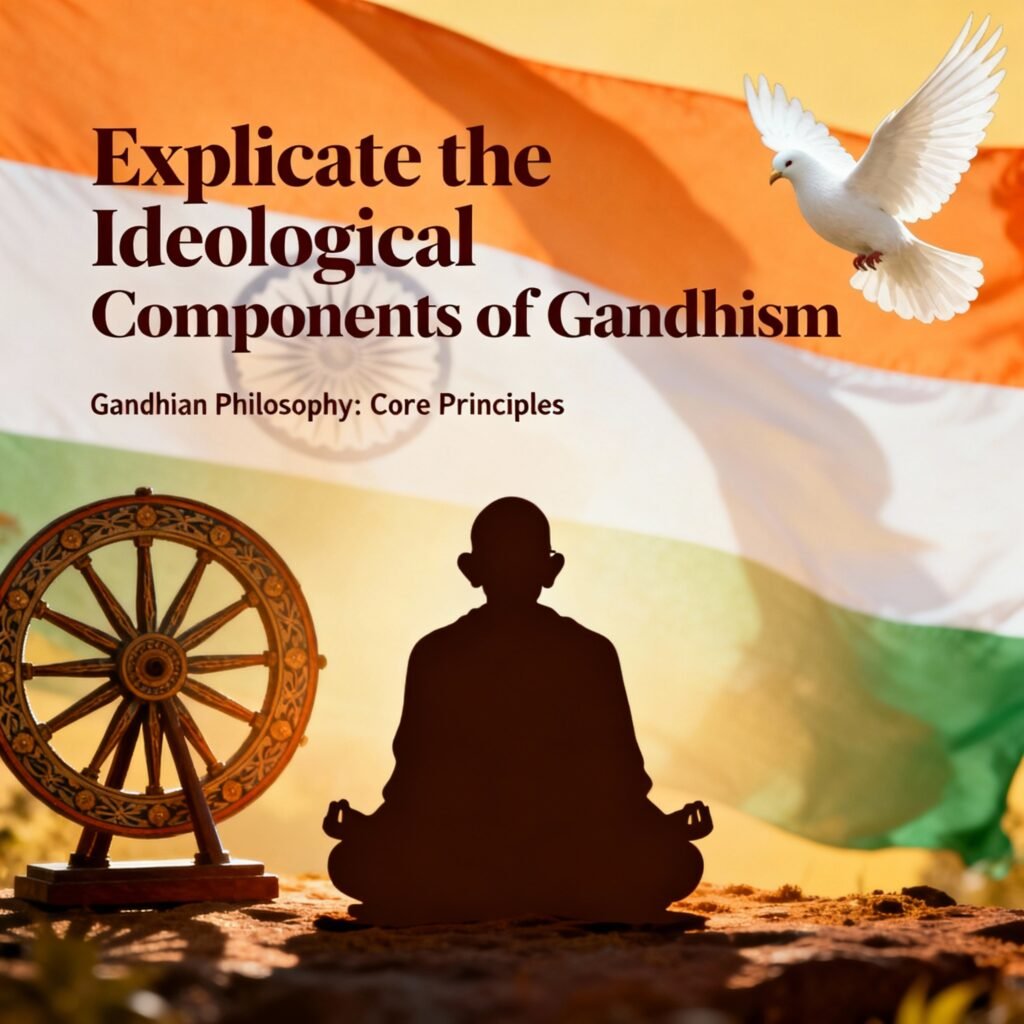
Explicate the Ideological Components of Gandhism. (2020/20M/250W/3a)
In the Political Science and International Relations (PSIR) syllabus of UPSC CSE, Gandhism holds a central place. While Karl Marx, Hobbes, and Locke built systematic theories, Gandhi’s thought emerged from lived experiences of colonial oppression and India’s struggle for freedom. His philosophy cannot be confined to narrow political science categories; it is simultaneously ethical, social, political, and economic.
For UPSC aspirants, understanding the ideological components of Gandhism is not just important for PSIR optional, but also relevant for GS Paper IV (Ethics), GS I (Modern Indian History), and Essay paper. However, quality answers on this topic are scarce online. This blog provides a model answer in 1000+ words, enriched with scholars, critical analysis, and contemporary relevance — useful for aspirants and researchers alike.
Core Philosophical Foundations of Gandhism
1. Truth (Satya)
- Gandhi equated Truth with God. For him, truth was both the end and the means of politics.
- In contrast to Machiavelli, who divorced ethics from politics, Gandhi insisted that political action must remain ethical.
- As Dennis Dalton observes, Gandhi placed “morality at the heart of political resistance,” making truth the anchor of his philosophy.
2. Non-Violence (Ahimsa)
- Gandhi’s non-violence is not mere pacifism; it is active love and moral confrontation of injustice.
- Ahimsa means restraint, compassion, and courage in the face of oppression.
- Unlike liberal tolerance, which accepts plurality, Gandhi’s ahimsa seeks to transform the oppressor through dialogue.
- As Raghavan Iyer puts it, “Non-violence is the most powerful weapon of the strong.”
Political Components of Gandhism
1. Satyagraha
- The most distinctive Gandhian political method.
- It rejects both Marxist violent revolution and purely legal constitutionalism.
- Through civil disobedience, non-cooperation, and constructive programs, Gandhi created a third path of resistance — one that appealed to universal conscience.
- Judith Brown notes that Gandhi’s satyagraha was “revolutionary because it transformed politics into a moral and spiritual exercise.”
2. Swaraj (Self-Rule)
- For Gandhi, Swaraj was more than political independence from colonialism; it was also self-discipline at the individual level.
- He envisioned bottom-up democracy, where villages functioned as self-sufficient republics.
- In contrast to Western liberalism, which focused on negative liberty, Gandhi emphasized positive freedom linked to duties and moral responsibility.
Economic Ideology of Gandhism
1. Village Economy & Decentralization
- Gandhi opposed both capitalist industrialism and socialist centralization.
- His charkha (spinning wheel) became the symbol of swadeshi and economic self-reliance.
- This approach resonates with modern degrowth theory and ecological economics, prioritizing human dignity over material accumulation.
2. Trusteeship
- Gandhi proposed trusteeship as a middle path between capitalism and socialism.
- Property owners should act as trustees, using surplus wealth for the welfare of society.
- Unlike Marx’s coercive redistribution, Gandhi emphasized voluntary moral responsibility.
- Critics question its practicality, but the concept anticipates corporate social responsibility (CSR) today.
Also View: Ambedkar’s Ideas on Constitutionalism: A Model Answer for UPSC PSIR
Social Transformation under Gandhism
1. Sarvodaya (Welfare of All)
- Gandhi’s vision of development was inclusive and ethical, prioritizing the poorest and most marginalized.
- Unlike Bentham’s utilitarian “greatest happiness of the greatest number,” Gandhi insisted on uplifting every individual, especially the weakest.
2. Religious Pluralism
- Gandhi’s idea of Sarva Dharma Sambhav (equal respect for all religions) was not Western secularism but spiritual inclusiveness.
- He sought a middle path between religious fundamentalism and militant atheism.
- This principle continues to inspire debates on secularism in India today.
Contemporary Relevance of Gandhism
- Environmentalism: Gandhi’s emphasis on small-scale production and restrained consumption anticipates today’s climate change discourse.
- Civil Rights Movements: Martin Luther King Jr. and Nelson Mandela drew heavily from Gandhian non-violence.
- Grassroots Activism: NGOs and movements like Chipko and Narmada Bachao Andolan reflect Gandhian constructive programs.
- Global Politics: Concepts of peacebuilding, conflict resolution, and sustainable development resonate with Gandhian principles.
Critical Analysis
- Strengths:
- Provides a moral foundation for politics.
- Anticipates modern sustainability debates.
- Offers alternatives to materialist ideologies of both capitalism and socialism.
- Limitations:
- Critics argue it is idealistic and impractical in modern nation-states.
- Trusteeship depends on voluntary goodwill, which is unreliable.
- In industrial and digital economies, Gandhi’s village-centered economics seems outdated.
Yet, Gandhi’s philosophy continues to inspire alternative development models, ethical politics, and non-violent resistance movements globally.
Conclusion
Gandhism represents a holistic ideological framework combining moral philosophy, political praxis, economic decentralization, and social inclusiveness. Unlike rigid Western ideologies, it is a living philosophy shaped by praxis. For UPSC aspirants, mastering Gandhism is crucial not only for optional PSIR but also for writing value-rich essays and ethics case studies. Despite criticisms, Gandhism remains relevant as a moral compass in contemporary politics, environmental discourse, and human rights struggles.
Also View: M.N. Roy’s Humanistic Marxism: Radical Humanism and Its Contemporary Relevance for UPSC PSIR
Quick Summary Table of Gandhi’s Ideology
| Component | Gandhian Idea | Distinctive Feature | Contrast With |
|---|---|---|---|
| Truth (Satya) | Truth = God | Ethics in politics | Machiavelli’s separation |
| Non-Violence (Ahimsa) | Active love | Transformative, not passive | Pacifism |
| Satyagraha | Moral resistance | Civil disobedience | Marxist violence |
| Swaraj | Self-rule + discipline | Village democracy | Liberal individualism |
| Trusteeship | Moral use of wealth | Voluntary redistribution | Marxist expropriation |
| Sarvodaya | Welfare of all | Upliftment of weakest | Utilitarianism |
| Religious Pluralism | Equal respect | Spiritually inclusive | Western secularism |
FAQs on Gandhism for UPSC
Q1. What is the core principle of Gandhism?
👉 Truth (Satya) and Non-Violence (Ahimsa) form its moral foundation.
Q2. How is Gandhian Swaraj different from Western liberty?
👉 It emphasizes duties, community, and moral responsibility over individual autonomy.
Q3. What is Gandhian Trusteeship?
👉 A principle where wealth holders act as custodians for society, promoting voluntary redistribution.
Q4. Why is Gandhism relevant today?
👉 It anticipates sustainable development, grassroots democracy, and peaceful resistance.
Q5. Is Gandhism practical in modern India?
👉 While critics find it idealistic, its ethical vision continues to influence politics, CSR, and environmental activism.
About The Author
