
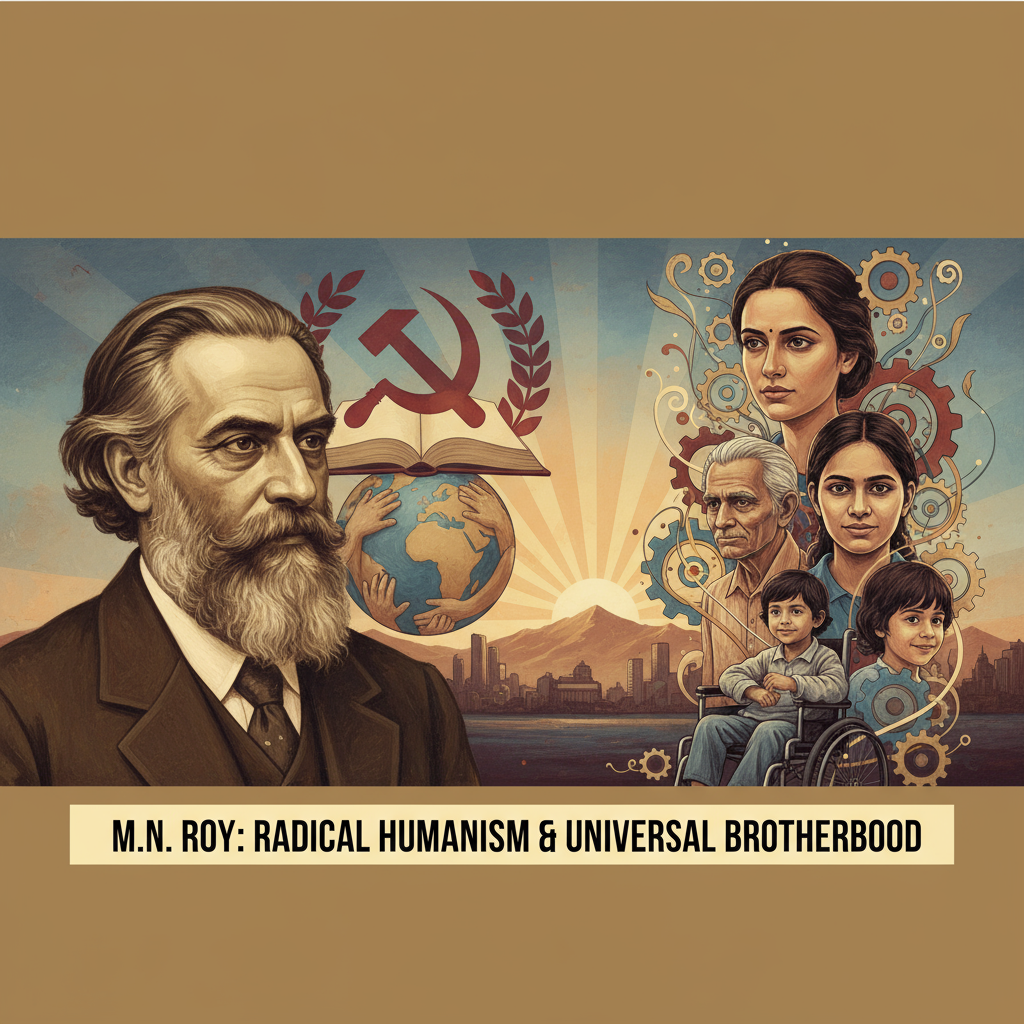
In the history of modern Indian political thought, Manabendra Nath Roy (1887–1954) stands out as one of the most original thinkers. His intellectual journey—from an early revolutionary, to a Marxist-Leninist, to eventually becoming the proponent of Radical Humanism—represents a remarkable trajectory of philosophical experimentation.
For UPSC PSIR aspirants, M.N. Roy is especially important because his thought bridges the gap between orthodox Marxism and humanistic democratic ideals. While most answers on Roy often remain limited to his break with communism, a deeper analysis highlights how he brought the humanist dimension into Marxism, emphasizing freedom, democracy, and moral values.
His critique of dogmatism and authoritarianism, coupled with his insistence on human reason and participatory democracy, continues to resonate with contemporary debates on socialism and democracy.
Understanding the Question: Manabendra Nath Roy’s political thought highlighted the humanistic aspects of Marxism. Discuss. 2024/15Marks
In simpler terms, we are required to:
- Explain how Roy critiqued orthodox Marxism.
- Highlight his humanistic orientation.
- Discuss his Radical Humanism.
- Critically assess his relevance in contemporary times.
Roy’s Critique of Orthodox Marxism
1. Departure from Economic Determinism
Roy started as a Marxist revolutionary but gradually grew critical of economic determinism. Unlike Karl Marx, who stressed the primacy of material conditions (base) shaping ideas and institutions (superstructure), Roy argued that human consciousness and ethical values cannot be reduced to economic factors alone.
👉 In his writings, Roy emphasized that “freedom is not merely the product of economic forces, but a conscious human choice.”
2. Critique of the Dictatorship of the Proletariat
Roy strongly opposed the Leninist and Stalinist model of dictatorship in the name of the proletariat. He believed this negated the very essence of socialism, which should rest on democracy and individual freedom. His critique anticipated later liberal and democratic socialist thinkers like Isaiah Berlin (on negative vs. positive liberty) and Karl Popper (critique of totalitarianism).
3. Human Agency and Ethics
Unlike orthodox Marxists, who stressed historical inevitability, Roy introduced the role of moral agency. He maintained that revolutions must not only transform structures but also cultivate ethical individuals.
The Philosophy of Radical Humanism
M.N. Roy’s Radical Humanism, most systematically articulated in his Twenty-Two Theses (1947), reflects his mature philosophy.
1. Rationalist Epistemology
Roy upheld reason and scientific inquiry as the foundation of political life. He rejected both religious dogma and Marxist fatalism. Social progress, according to him, must be guided by human reason, not blind faith in historical inevitability.
2. New Humanism
Roy coined the idea of “New Humanism”—a system that recognizes human dignity, individual freedom, and ethical responsibility as the foundation of a just society. Unlike Marxists who believed history had a predetermined end (communism), Roy believed history is open-ended and shaped by conscious choices.
3. Organized Democracy
Roy proposed the idea of organized democracy, a decentralized system based on local self-governing units. This anticipates modern concepts like deliberative democracy (Jürgen Habermas, Joshua Cohen). Instead of a centralized state, he envisioned a participatory democracy where people actively engage in governance.
4. Beyond Class Struggle
While remaining committed to socialism, Roy shifted the focus from class struggle to human freedom and dignity. He criticized both capitalist exploitation and socialist authoritarianism, offering an alternative path that blends economic equality with moral freedom.
Also View: Explicate the Ideological Components of Gandhism – UPSC PSIR Model Answer
Critical Assessment of Roy’s Humanistic Marxism
Strengths
- Bridging Marxism and Humanism: Roy offered a middle path between materialist determinism and ethical idealism.
- Democratic Socialism: His critique of Stalinist authoritarianism was ahead of his time, aligning with later movements of democratic socialism.
- Relevance for India: His emphasis on decentralized democracy resonates with India’s panchayati raj system and grassroots governance.
- Influence on Later Thought: His ideas anticipate Amartya Sen and Martha Nussbaum’s Capabilities Approach, which prioritizes human development and freedom over mere economic growth.
Limitations
- Philosophical Inconsistency: Critics argue his synthesis of Marxist analysis with humanist ethics creates contradictions.
- Weak Political Base: Radical Humanism remained largely a philosophical exercise with little mass political influence.
- Rejection by Orthodox Marxists: Communists dismissed his thought as “bourgeois deviation.”
- Overemphasis on Morality: Some argue that excessive reliance on ethics makes his theory less practical in realpolitik.
Contemporary Relevance
Roy’s thought continues to inspire debates in political philosophy and practice:
- Democratic Socialism: His ideas resonate with thinkers like Michael Harrington and David Schweickart, who advocate for democratic forms of socialism.
- Third Way Politics: His rejection of both capitalism and authoritarian socialism parallels modern debates on the “third way” between market and state control.
- Human Development: The focus on human dignity aligns with the UNDP’s Human Development Index and capabilities-based frameworks.
- Decentralized Governance: In an era of centralization, Roy’s vision of participatory democracy holds fresh relevance.
Conclusion
M.N. Roy’s intellectual journey from Marxist revolutionary to radical humanist reflects his tireless search for a philosophy that harmonizes economic justice, human freedom, and ethical responsibility. His critique of determinism, rejection of authoritarianism, and advocacy of organized democracy make him a pioneering figure in modern political thought.
For UPSC aspirants, Roy’s significance lies in his unique attempt to humanize Marxism, making socialism compatible with democracy and individual liberty. While his Radical Humanism did not evolve into a mass movement, his philosophical contributions continue to inspire political discourse, offering valuable insights into how social justice can coexist with freedom and reason.
Also View: Comment on Ambedkar’s ideas on constitutionalism.
🔹 Quick Revision Table: M.N. Roy’s Humanistic Marxism
| Aspect | Orthodox Marxism | M.N. Roy’s Critique | Radical Humanism (Roy’s Alternative) |
|---|---|---|---|
| Determinism vs Agency | History driven by economic base | Rejected economic determinism | Emphasized human reason & moral agency |
| Dictatorship of Proletariat | Justified as transitional phase | Opposed as authoritarian | Advocated organized democracy & freedom |
| Ethics | Subordinate to class struggle | Criticized lack of moral dimension | Introduced ethical responsibility |
| Religion & Dogma | Religion as false consciousness | Rejected Marxist fatalism & blind faith | Stressed rationalism & scientific inquiry |
| Democracy | Suspended under proletarian rule | Condemned one-party authoritarianism | Proposed decentralized participatory democracy |
| Goal of Socialism | Classless society via revolution | Saw limits of class struggle | Human development, dignity & freedom |
| Contemporary Link | Influenced communist regimes | Critic of Stalinism | Anticipated Amartya Sen’s Capabilities Approach, deliberative democracy |
FAQs on M.N. Roy’s Political Thought
Q1. Who was M.N. Roy?
M.N. Roy (1887–1954) was an Indian revolutionary, Marxist theorist, and later founder of Radical Humanism.
Q2. What was Roy’s main critique of orthodox Marxism?
He rejected economic determinism and dictatorship of the proletariat, stressing human reason and freedom over blind historical inevitability.
Q3. What is “Radical Humanism”?
Radical Humanism, outlined in his Twenty-Two Theses (1947), emphasized reason, ethics, and participatory democracy as the basis of socialism.
Q4. What is Roy’s idea of “New Humanism”?
“New Humanism” was his call for a human-centered philosophy, where dignity and ethical responsibility guide social progress.
Q5. What does Roy mean by “Organized Democracy”?
Organized Democracy refers to a decentralized political system built on local self-governing units and direct citizen participation.
Q6. How did Roy view Stalinism?
He strongly opposed Stalinist authoritarianism, arguing that true socialism must respect liberty and democracy.
Q7. Why is M.N. Roy called a Humanist Marxist?
Because he combined Marxist concern for economic justice with humanistic ideals of freedom, dignity, and ethics.
Q8. What is the contemporary relevance of Roy’s thought?
His ideas anticipate the Capabilities Approach (Amartya Sen, Nussbaum), deliberative democracy, and democratic socialism.
About The Author
