
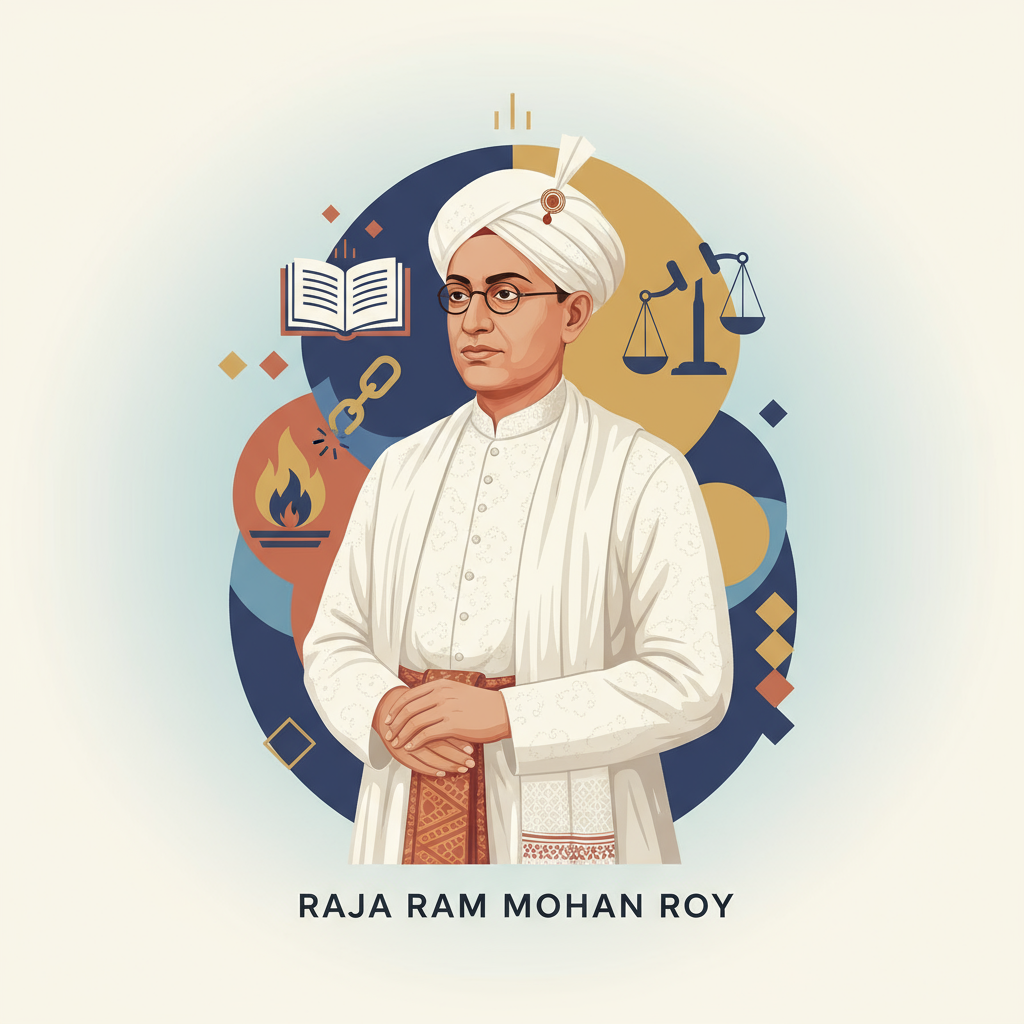
Q. Consider the following statements about Raja Ram Mohan Roy:
I. He possessed great love and respect for the traditional philosophical systems of the East.
II. He desired his countrymen to accept the rational and scientific approach and the principle of human dignity and social equality of all men and women.
Which of the statements given above is/are correct?
[A] I only
[B] II only
[C] Both I and II
[D] Neither I nor II
Answer: (C) Both I and II
Overview of Raja Ram Mohan Roy for UPSC CSE
- Born: May 22, 1772, Radhanagar, Bengal
- Died: 1833
- Contributions: Central figure in political and social awakening in India; key reformer of 19th century.
- Legacy: Father of Indian Renaissance, pioneer of modern India.
Analysis of Statements
Statement I — Respect for Eastern Philosophical Systems ✅
- Roy had great admiration for traditional Eastern philosophy, especially the Vedas and Upanishads.
- He emphasized universalism and monotheism in Indian religion.
- He defended the moral and ethical principles of all religions while critiquing idol worship and ritualism.
- Intellectual synthesis of Oriental and Occidental thought was central to his outlook.
Example Works:
- Translations of the Vedas and Upanishads into Bengali.
- Tuhfat-ul-Muwahhidin (Gift to Monotheists, 1803) – advocacy for monotheism.
Statement II — Advocacy for Rationalism and Social Equality ✅
- Roy strongly believed in rational, scientific approach as the basis for truth.
- Promoted human dignity and social equality for men and women.
- Advocated for modern education, industrialization, and capitalism.
- Critiqued social ills like Sati, child marriage, polygamy, and lack of female education.
Key Social Reforms:
| Reform | Year / Action | Significance |
|---|---|---|
| Abolition of Sati | 1829 (Regulation XVII) | Protection of widows; eradication of barbaric customs |
| Promotion of Female Education | 1820s | Empowerment of women; social progress |
| Opposition to Child Marriage & Polygamy | Early 19th century | Advocacy for equality and rational social practices |
| Founding of Anglo-Hindu School | 1822 | Curriculum combining Indian and Western knowledge |
| Vedanta College | 1826 | Teach monotheism alongside modern sciences |
Religious and Intellectual Contributions
- Criticized idol worship and superstitious practices.
- Advocated interfaith dialogue and tolerance.
- Publications:
- Precepts of Jesus (1820) – moral and philosophical teachings separated from miracles.
- Persian and Bengali newspapers promoting rational thought and reform.
Social and Educational Contributions
- Atmiya Sabha (1814): Philosophical discussion forum addressing social ills.
- Promoted freedom of the press via publications like:
- Brahmanical Magazine (1821)
- Samvad Kaumudi (1821, Bengali weekly)
- Mirat-ul-Akbar (Persian weekly)
Also See: All the Economics PYQ asked in UPSC CSE Prelims
Summary Table of Contributions: Short Notes on Raja Ramohan Roy on UPSC CSE
| Domain | Key Contributions |
|---|---|
| Social Reform | Abolition of Sati, opposition to child marriage & polygamy, women’s education |
| Education | Anglo-Hindu School, Vedanta College, modern curriculum integrating Western sciences |
| Religion & Philosophy | Monotheism, critique of idol worship, interfaith tolerance, translations of Vedas/Upanishads |
| Media & Awareness | Newspapers and magazines advocating rationalism and reform |
Key Takeaways for UPSC
- Raja Ram Mohan Roy = Father of Indian Renaissance
- Advocated modern education, rational thinking, social reforms
- Combines Eastern philosophy + Western rationalism
- Major social reforms: Abolition of Sati, promotion of female education, opposition to regressive practices
- Founded Atmiya Sabha, Anglo-Hindu School, Vedanta College
Other PYQs asked on Raja Ramohan Roy in UPSC CSE
Question 1: Trace the rise and growth of socio-religious reform movements with special reference to Young Bengal and Brahmo Samaj. (UPSC Mains 2021)
Question 2:The women’s questions arose in modern India as a part of the 19th-century social reform movement. What are the major issues and debates concerning women in that period? (UPSC Mains 2017)
Which of the following statements is/are correct regarding Brahmo Samaj? (UPSC Prelims 2012)
- It opposed idolatry
- It denied the need for a priestly class to interpret the religious texts
- It popularised the doctrine that the Vedas are infallible.
Select the correct answer using the codes given below:
(a) 1 only
(b) 1 and 2 only
(c) 3 only
(d) 1, 2 and 3
Answer: (b)
FAQs on Raja Ramohan Roy
Q1. What was the Atmiya Sabha?
A philosophical discussion society founded by Roy in 1814 to debate social and religious reforms.
Q2. Which law abolished Sati and who influenced it?
Regulation XVII, 1829; lobbying and campaigns by Raja Ram Mohan Roy.
Q3. What was Roy’s approach to religion?
Advocated monotheism
Critiqued ritualism and idol worship
Emphasized ethical teachings and morality
Q4. How did he contribute to education?
Founded Anglo-Hindu School (1822) and Vedanta College (1826) combining Indian and Western knowledge systems.
Q5. Name some publications by Roy.
Tuhfat-ul-Muwahhidin (1803)
Precepts of Jesus (1820)
Newspapers: Brahmanical Magazine, Samvad Kaumudi, Mirat-ul-Akbar
About The Author
