
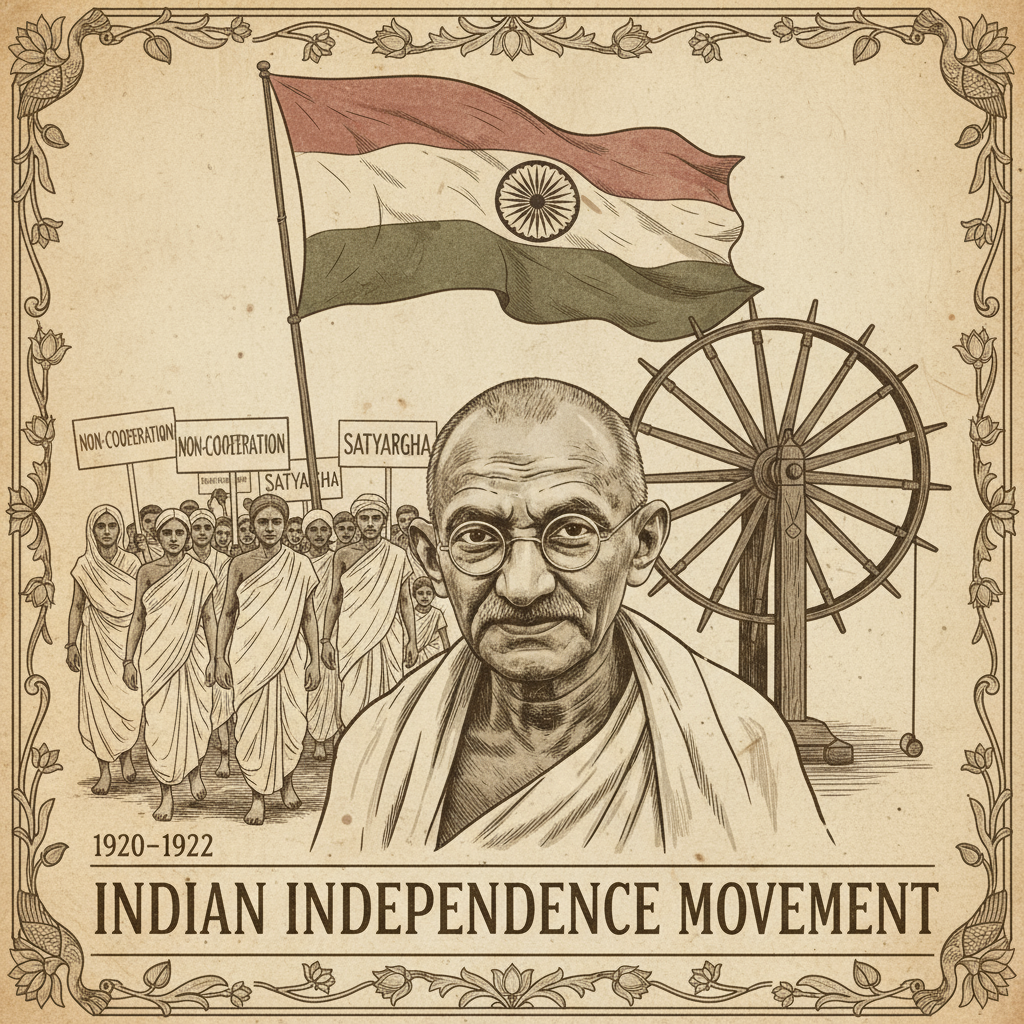
Q. Consider the following subjects with regard to Non-Cooperation Programme:
I. Boycott of law-courts and foreign cloth
II. Observance of strict non-violence
III. Retention of titles and honours without using them in public
IV. Establishment of Panchayats for settling disputes
How many of the above were parts of the Non-Cooperation Programme?
[A] Only one
[B] Only two
[C] Only three
[D] All four
Answer: (C) Only three
Overview of the Non-Cooperation Movement for UPSC CSE Prelims
- Launched by: Mahatma Gandhi
- Year: 1920
- Objective: To withdraw Indian support from British institutions and demand Swaraj (self-rule) through peaceful, non-violent means.
- Approval: Special session of the Indian National Congress, Calcutta, September 1920; endorsed at Nagpur session, December 1920.
Key Features of the Non-Cooperation Programme
Statement Analysis
Statement I ✅: Boycott of law-courts and foreign cloth
- Included boycotts of law courts, government schools and colleges, and foreign goods.
- Promotion of Swadeshi goods and hand-spinning (Khadi).
- Thousands of students and professionals resigned from schools, colleges, and legal practices.
Statement II ✅: Observance of strict non-violence
- Central to Gandhi’s strategy.
- Protest was peaceful, avoiding physical violence.
Statement III ❌: Retention of titles and honours without using them in public
- INC encouraged renunciation of British-conferred titles (not retention).
Statement IV ✅: Establishment of Panchayats for settling disputes
- National/parallel institutions were established for dispute resolution.
- Strengthened local governance outside British control.
Features & Methods of the Non-Cooperation Movement
| Feature | Description |
|---|---|
| Boycott of British Institutions | Law courts, government schools and colleges, official positions, and local bodies |
| Swadeshi Movement | Adoption of Khadi, hand-spinning, boycott of foreign goods |
| Panchayats | Local councils for dispute resolution, alternative to British courts |
| Non-violence | Central principle of protest and social mobilization |
| Surrender of Titles | Renunciation of honorary titles conferred by British (showcases that UPSC CSE is asking minute details) |
| Jail Bharo Andolan | Volunteers willingly imprisoned to protest British authority |
| Promotion of Communal Harmony | Focus on Hindu-Muslim unity during protests |
| National Institutions | National schools and colleges like Kashi Vidyapeeth, Bihar Vidyapeeth, Jamia Millia Islamia |
Spread of the Movement Across India
| Region | Key Leaders | Activities |
|---|---|---|
| Bengal | Birendranath Sasmal | Anti-union board agitation |
| Assam | J.M. Sengupta | Strikes in tea plantations, railways |
| UP / Awadh | Baba Ram Chandra | Peasant uprisings, Eka movement |
| Punjab | Akali Leaders | Gurudwara reform, communal unity |
| Gujarat | Vallabhbhai Patel | Spread of non-violent alternatives |
| Andhra | Alluri Sitaram Raju | Tribal & peasant protests, non-payment of taxes |
| Tamil Nadu / Kerala | C. Rajagopalachari, S.Satyamurthy, Periyar | Anti-liquor, boycott of foreign cloth |
Comparison with Civil Disobedience Movement (1930)
| Feature | Non-Cooperation Movement | Civil Disobedience Movement |
|---|---|---|
| Launch Year | 1920 | 1930 |
| Objective | Swaraj through non-cooperation | Complete independence; Salt law protest |
| Form of Protest | Boycott, resignations, non-payment of taxes | Salt Satyagraha, tax refusal, picketing liquor & foreign cloth shops |
| Leadership | Mahatma Gandhi | Mahatma Gandhi |
| Scope | Legal and institutional boycott | Direct action against specific laws (Salt Laws) |
| Mass Participation | Students, lawyers, peasants | Wider mass mobilization including women & tribals |
| Outcome | Highlighted colonial exploitation; halted after Chauri Chaura | Escalated to nationwide civil disobedience, increased global attention |
Key Takeaways for UPSC
- The Non-Cooperation Movement was India’s first nationwide mass movement under Gandhi.
- Key strategies: Boycott, non-violence, Swadeshi, renunciation of British titles.
- Parallel institutions: National schools, colleges, Panchayats for dispute resolution.
- Spread: Movement reached multiple regions including Bengal, UP, Punjab, Gujarat, Andhra, Tamil Nadu, and Kerala.
- Significance: Laid the foundation for future mass movements, including the Civil Disobedience Movement (1930).
Also See: Raja Ram Mohan Roy: UPSC CSE Prelims PYQ 2025 Solved
FAQs
Q1. Why was the Non-Cooperation Movement called off in 1922?
Due to the Chauri Chaura incident, where protesters turned violent, Gandhi called off the movement to maintain non-violence.
Q2. What was the role of Panchayats in the movement?
Established local dispute resolution bodies as alternatives to British courts.
Q3. How did Swadeshi and Khadi promotion support the movement?
Reduced dependence on foreign goods, boosted self-reliance, and symbolized resistance against British economic exploitation.
Q4. Name some national institutions established during the movement.
Kashi Vidyapeeth, Bihar Vidyapeeth, Jamia Millia Islamia
Q5. Which key leaders resigned from law practice during the movement?
C.R. Das, Motilal Nehru, C. Rajagopalachari, M.R. Jayakar, Vallabhbhai Patel, Asaf Ali
About The Author
